
All the basic rules for our club and USCF tournaments
Piermont Chess culture is inclusive & encouraging. Let’s keep it that way.
Please familiarize yourself with these common sense rules for casual play and tournaments.
GENERAL
- Please stay home if you are sick.
- Dress Appropriately.
- Food & Drink are allowed. We provide coffee, water, and snacks. You may also bring your own.
- Please keep chess equipment CLEAN. No sticky fingers etc!
- Please protect the equipment. You break it? You buy it. Clocks especially.
- Please clean up after yourself. Toss your trash, wipe up crumbs & spills etc.
- Please practice good sportsmanship at all time. Be supportive. Be polite. It’s a game.
- Please control your emotions and language. ( Note to parents: we welcome children, but adult language may be heard.)
- Please NO vulgar language, intimidation, bullying, sexual harassment, or inappropriate/excessive trash talk/teasing. (Director is certified in SafeSport anti-harassment/bullying and will report incidents to authorities as required by law. If you experience anything of the sort, tell the director immediately.)
- Please try not to overwhelm new players with your passion. We know you love to share your chess knowledge, but please don’t over do it.
- No weapons.
- No drugs or alcohol. Consumption, or possession.
TOURNAMENTS
- Silence at all times.
- Please avoid distracting noises. Coughing, burping, sniffling, heavy breathing, stomping, chewing, slurping etc.
- NO FOOD AT THE BOARD – DRINKS ONLY.
- You may QUIETLY stand, walk around, & use the bathroom etc. during a match.
- Electronic devices (headphones, watches, phones, tablets etc.) ARE permitted.
- ALL DEVICES must be silent or off, but you may keep them.
- Texting is tolerated but should be minimized. Phone calls must be made in the hallway.
- Please do not discuss your games in the game room. Move to the hallway to talk, and still, keep it down.
- NO CHEATING. We trust you. Don’t violate that trust.
- DO NOT ask for, or give, advice during a tournament. Including non verbal gestures etc.
- DO NOT interfere with a game in progress.
- You may quietly play casual games between rounds IF there is space. There will be signs for “casual chess.”
- PLEASE DO NOT TOUCH THE TOURNAMENT BOARDS unless you are playing a match.
- DO NOT TOUCH THE DGT BOARDS. The digital boards are recording the tournament games and you will mess them up.
- Spectators include parents, family, friends, and registered players not currently engaged in a match.
- Players may bring family and friends – within reason (no more than 4 please.)
- Spectators must follow all rules listed and may be asked to leave if they do not cooperate.
- Do not crowd a player or game. Stand back at least 3 feet.
- Do not speak to any player EVER or offer any advice, including inadvertent facial expressions, or audible noises that may communicate to a player.
- Parents should stand BEHIND their player or otherwise out of view to avoid conflict.
- Move around the room as quietly as possible.
- Silence in general at all times.
- Use common sense regarding food, drinks, phones off, etc.
- Piermont Chess provides all necessary equipment for tournaments and casual. Players do not need to bring anything other than a positive attitude & some family and friends.
- Players must use the club equipment at tournaments. For standardization and fairness we ask everyone to use our sets and clocks.
- Register for tournaments online using credit or debit, or in person at the club where we can accept cash or venmo.
- All rated tournaments require all players to have an active membership with The US Chess Federation (USCF). Join/renew here
- We list events on this website, on USCF, Facebook, Instagram, and in our weekly newsletter. Subscribe to get the latest news and updates.
- Unfortunately we do not offer refunds. This is so players commit to attending. You may apply credit toward a future event. Contact us to set that up or to discuss a special situation.
- If you know you will be late please call or text at (845) 273-0303 ASAP. If we don’t hear from you we will start your clock. If you miss the first game with no contact, you will be withdrawn.
- When you arrive, introduce yourself to the Tournament Director and confirm your participation in the event.
- The tournaments will begin @11am after a short presentation of the rules. Most events last ~4 hrs.
- Please arrive @ 10:30a to check-in. Doors to the building open at 10am.
- We are a casual and social club. We are not in a rush and we like to give everyone time to relax and chat before starting and in-between rounds.
- A time control is the amount of time each player has to make their moves.
- It is written as “G/#” which means “game in # minutes.”
- A time control will often include a bonus or a delay. For example: “G/25+5” means “game in 25 minutes plus 5 seconds per move.” OR “G/25;d10” which means, “game in 25 minutes with 10 second delay per move.”
- At PCC we use different time controls for each event so be sure to read listings carefully.
- Some common ones are G/3+2, G/15+10, G/25+0, G/45+15, G/60;d30 etc.
- Time controls refer to one player’s time, so a game may last double that time eg: G/25+5, is considered a “30 minute game” which can last up to ~60 minutes accounting for both players.
- Time controls can be referenced with the terms Blitz, Rapid, or Classical which are common descriptors of the game speed: fast, medium, & slow, respectively.
- US Chess rates your games based on their time control.
- There are 3 rating categories: Blitz, Quick, Regular. (We don’t use the “online” one).
- These are official terminology. Terms like Rapid or Classical are technically meaningless.
- The time control of the event determines which category will be affected:
- Blitz rated: Any game 5-10 minutes with a minimum base time of 3 minutes (e.g. G/3+2 = 5 minutes)
- Quick rated: Any game greater than 10 but less than 30 minutes (e.g. 10m01s – 29m59s) with a minimum base of 5.
- Dual rated (both quick and regular): Any game 30-65 minutes with a minimum base of 5. (eg: G/45+10)
- Regular rated: Any game greater than 65 minutes with a minimum base of 5. (eg: G/90+30)
- Most chess tournaments are run in a Swiss System format, which means there is a set number of rounds and everyone will play in each round, and players are paired based on rating first, followed by their results in subsequent rounds.
- Other formats include round robin, and elimination.
- Scoring: Win = 1 point. Lose = 0 points. Draw = 1/2 point. Highest score wins.
- In the event of a tie special algorithms are applied to determine a victor. Cash prizes are split evenly.
- Arrive early and check in.
- The TD will announce the start of the event, do a roll call, and review the rules.
- The TD will announce the pairings. Pairings are projected on the TV. At this point registration is officially closed.
- Find your name, board number and piece color. Take a score sheet and pen if required, and take your seat.
- Fill out the top portion of the score sheet.
- When everyone is settled the TD will say to begin.
- Set the clock to White’s turn.
- Shake hands or bump fists with your opponent and say, “Good luck.”
- Black starts the clock by pressing the play button.
- If a player is late, their opponent may start the clock in their absence. (Black starts the clock and waits, White may start the clock, make a move and start Black’s clock.)
- Players take turns making a move, pressing the clock, and recording moves if required.
- When the game is over, shake hands again, say, “Good game” and stop the clock.
- Reset the pieces and the clock.
- Report the results to the TD. Say the board number and which color won.
- Pause the clock to ask the TD for assistance at any time during the game.
- It is important to know how to operate the clock.
- At PCC we use the blue DGT North American model.
- It will be set for the event.
- Players need to know how to start, pause, and reset.
- In each game the player with Black pieces starts the clock.
- Press the middle button with the play/pause symbol.
- Press again to pause.
- The on/off button is on the bottom of the clock.
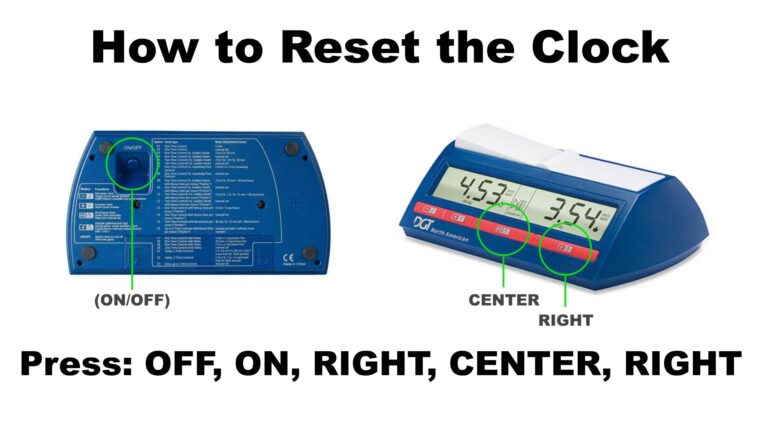
- To reset the clock on a manual setting, lift it up and press: Off; On; Right Button; Center Button; Right Button again. The clock will show the last used settings and be ready to start.
- To reset the clock on a preset setting, press: Off; On; Right Button
- Players sometimes have to skip a round. This is called a “bye.”
- There are two ways to receive a bye.
- Requested Bye: To accommodate a player with a conflict or illness. Bye requests must be made before the last round so they cannot be used strategically to influence an event. Players who request a bye will receive a 1/2 point for the round. Skipping the last round is considered a withdraw and gets 0 pts.
- Assigned Bye: is offered due to a lack of an opponent from forfeit/withdrawal, or an odd number of players. These are given once per round to the lowest rated player, with the fewest wins, who hasn’t had a bye already. That player receives 1 point for the inconvenience regardless of the round.
- There are strict rules regarding how to move the pieces.
- One Hand Rule: One hand must do all the work e.g. the hand that moves a piece should also operate the clock. Same for promotion and castling.
- Touch Move/Touch Take Rule: a piece touched with intent to play must be moved unless illegal to do so (touch move). As well, an opponent’s piece that is touched with intent to capture it must be captured unless illegal to do so (touch take).
- J’adoube/Adjust: a player may only touch a piece to adjust it IF it is their turn, and they say out loud “J’adoube” “I Adjust” or “Adjust.”
- Castling: the proper way to castle is to move the king first and the rook second using the same hand.
- Pawn Promotion: remove pawn from the board (it doesn’t have to touch the 8th rank), and place the promoted piece on the 8th rank using the same hand.
- Captured pieces are out of play and can be held or placed anywhere on the table.
- Illegal moves are any move that violates the standard rules of piece movement. (See How to Play Chess).
- A move is NOT illegal UNTIL the turn is COMPLETED by pressing the clock. A player may correct an illegal move before they press the clock.
- Illegal moves must be DECLARED by the opponent BEFORE completing their next move or no penalty can be applied and play continues. Responsibility lies with the last illegal move if multiple are made.
- Declare an illegal move by pausing the clock and calling the TD.
- Illegal moves incur a 2 minute time penalty where the non-offending player receives +2 minutes. The board is reset to the position before the move was made.
- In Blitz time controls, an illegal move loses the game immediately.
- If the illegal move is castling, reset the king and rook and make a king move as castling is considered a king move.
- Notation is required for any game 30 minutes or longer (Dual rated or Regular)
- Quick and Blitz do not require notation.
- In any game requiring notation, both players may stop taking notation once either player has fewer than 5 minutes remaining.
- Any game with a +30 second increment requires notation throughout.
- Notation can be made at any time.
- You can borrow your opponent’s sheet to correct yours but you must do it on YOUR TIME.
- Players with inexperience or disability may use an assistant, digital devices, request a time penalty of -5%, 10 minutes maximum (20= -1min), or be excused at TD discretion.
Algebraic Notation:
- Rows 1, 2, 3, 4, 5, 6, 7, 8 are “Ranks”; Columns a, b, c, d, e, f, g, h – are “Files”
- Each square has a coordinate address, a letter and a number. “a1, b2, c3, d4, etc”
- Initials for pieces: King= K; Queen= Q; Knight= N; Bishop= B; Rook= R; Pawn= the letter of the square it is currently on.
- Move: Note the piece that moved and the new square, “Queen to e4” = “Qe4”, for pawns just mark the new square eg: “e4.”
- Capture: Add an x for “takes”, “Queen takes e4” = “Qxe4”. For pawns, record the letter it started on and the new square, “dxe4”
- Check: Add a plus + sign “Queen to e4, Check” = “Qe4+”
- Checkmate: Add a hashtag “Queen to e4, Checkmate” = “Qe4#”
- Note the winner in the space after the last move:
- White wins: 1-0
- Black wins: 0-1
- Draw/stalemate: 1/2-1/2
Special cases:
- Capture En Passant: add “e.p.” = “axb6 e.p.”
- Castle: king-side O-O (short castle); queen-side O-O-O (long castle)
- Pawn promotion: add equal sign and promoted piece “a8=Q”
- Knights that can both move to the same square: specify which knight with the letter they are on, or the number if they have the same letter: “Knight on b to d4” = “Nbd4” or “Knight on 2 to d4” “N2d4”
- Rooks on the same rank or file: Similar to knights, specify the file if on same rank “Rad8″ or rank if on same file “R4d2″
- Game ends on checkmate, draw, resignation, or expired time.
- Checkmate: Game ends immediately with a legal Checkmate on the board. Supersedes flag fall if completed before flag is declared.
- Draw: Draws can occur by player agreement (all moves lead to no change), stalemate (king trapped but not in check and no other pieces can move), 3 time repetition (same position repeated 3 non-consecutive times), 50 move rule (50 moves with no pawn move or capture), lack of material (not enough pieces to create checkmate), and “double flag” time expire (both players run out of time without a declaration). Say out loud “DRAW?” and offer a handshake.
- Time expire: Player who runs out of time loses, but opponent must declare it before they too run out of time.
- Resignation: player gives up. Say out loud “I Resign” and offer your hand to shake.
- Confirm all results verbally with opponent. ( Many draws were mistaken for resignations and vice versa.)
- Record results on score sheet Black 0-1; White 1-0; Draw 1/2-1/2.
- Report to TD board number and which color won.
- Prizes are listed as “Prizes b/20”, meaning “based on 20 players.”
- The prize fund is usually 50% of the entry fees and split into place and class prizes.
- They will be listed like this: “$100-80; $60 U1800.” This means $100 for first place, $80 for second place and $60 for the best score for a player rated under 1800.
- Cash prizes are split evenly in the event of a tie as per USCF.
- Tie break algorithms are used to determine the standings and the winner of prizes that cannot be divided, like trophies, Or players can agree to play a blitz tie break game.